Sunday, May 3, 2026
3:00 PM
New England Congregational Church
406 W. Galena Blvd., Aurora, IL
with guests Stephen Boe (viola) and Mathias Tacke (violin)
3:00 PM
New England Congregational Church
406 W. Galena Blvd., Aurora, IL
7:30 PM
PianoForte Studios
1335 South Michigan Ave., Chicago, IL
7:30 PM
Music Institute of Chicago, Nichols Concert Hall
1490 Chicago Ave., Evanston, IL
After 35 years of presenting a vast repertoire, including clarinet trios, quartets and quintets and piano and string trios, quartets and quintets, spanning the greatest standard repertoire to new compositions written for us, we've decided the time has come to conclude our work together. We thank all the wonderful guest musicians who have performed with us and our dedicated audiences who have supported us all these years. We have loved this amazing journey and are grateful for everything we have accomplished together.
We chose this special repertoire for our last concert because it has deep significance in our many years spent together. The Khachaturian Clarinet Trio is one of our favorites; we performed it early on in our concert series and throughout the country on tours. It showcases all three instruments and our creative style. The Prokofiev is a gorgeous, soulful piece that features our core ensemble and our favorite guests, and the Brahms Quintet in F minor is one of the most beloved pieces of all time.
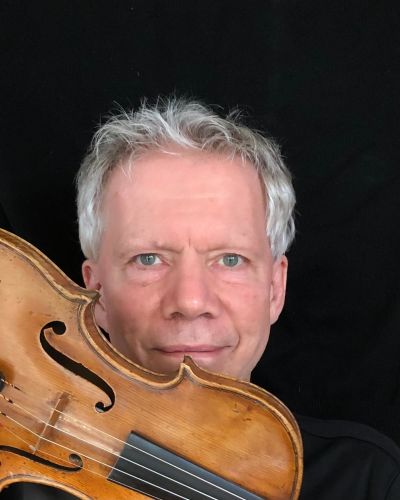
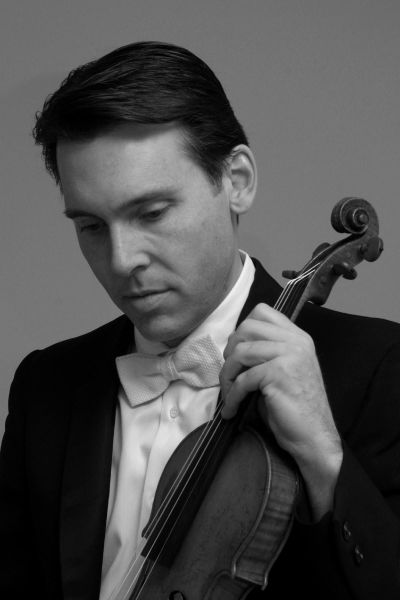
Orion's founding members—clarinetist Kathryne Pirtle, violinist Florentina Râmniceanu, cellist Judy Stone and pianist Diana Schműck—will be joined by longtime guest musicians Stephen Boe (below R), viola, and Mathias Tacke (below L), violin.
Aram Khachaturian (1903-78) composed the Trio for Clarinet, Violin and Piano in 1932. Although he was still a student, the work shows his clear command of compositional technique and a mature ability to convey a depth of emotion via expressive sweeping lines. While the work does not quote actual folk music, it is rich in original melodies that welled up from the Tbilisi-fed spring of music within Khachaturian, and it creates timbres similar to East Asian folk instruments, with which he was familiar. The first movement is rhapsodic, the second more rhythmic and driving. The likeable finale develops one folk-like melody through instrumentation, texture and tempo.
Sergei Prokofiev (1891-1953) created the Overture on Hebrew Themes for Clarinet, Two Violins, Viola, Cello and Piano, Op. 34 (1919) after clarinetist Simeon Bellison requested a work for his group, the Zimro Ensemble, supplying a collection of Jewish melodies as inspiration. Despite the borrowed tunes, the short Overture is replete with Prokofiev's characteristically colorful style. Indeed, the composer captured the essence of the richly expressive Hasidic tunes, yet masterfully made them his own, casting them within a standard sonata form. The work opens with a vamping accompaniment in the strings (including piano) followed by the initial statement of the first theme, a playful, rhythmic dance, in the clarinet. The second theme is, in contrast, more lyrical and plaintive. Prokofiev ends the piece with an exuberant coda that highlights snippets of the first dance theme.
The Quintet in F minor for Two Violins, Viola, Cello and Piano, Op. 34 by Johannes Brahms (1833-97) began as a string quintet, but Brahms was not satisfied and rearranged it for two pianos, then rewrote it again for this final instrumentation. The relatively short first movement has a plethora of varied and expressive themes; the second movement is the epitome of tenderness and beauty; the third movement is energetic and exciting. A slow introduction leads into a grandiose finale.