Sunday, November 10, 2024
3:00 PM
New England Congregational Church
406 W. Galena Blvd., Aurora, IL
with guests Stephen Boe (viola) and Mathias Tacke (violin)
3:00 PM
New England Congregational Church
406 W. Galena Blvd., Aurora, IL
7:30 PM
PianoForte Studios
1335 South Michigan Ave., Chicago, IL
7:30 PM
Music Institute of Chicago Nichols Hall
1490 Chicago Ave., Evanston, IL
Otono en Buenos Aires, La Alborada de la Esperanza, Limoncello
Jose Elizondo (b. 1972)
An engineer as well as a musician, Elizondo is a multifaceted Mexican-American composer with degrees in electrical engineering and computer science, as well as humanities and music, from MIT. He studied music analysis and choir and orchestra conducting at Harvard. He writes chamber and orchestral music that often draws inspiration from Latin-American folk music. Otono en Buenos Aires (Autumn in Buenos Aires), which Orion pianist Diana Schmück performs on this concert program, is inspired by the music of Astor Piazzolla and the tangos of Carlos Gardel. La Alborada de la Esperanza (The Dawn of Hope) recognizes the 100th anniversary of the Armistice ending World War I and represents, in the composer's words, "the journey from darkness to light." Finally, Limoncello is a playful title, inspired by thoughts of the gentle Mediterranean breeze, the sparkling reflection of light on an Italian fountain and the beautiful, bright yellow color of the Italian limoncello drink that evokes the splendid midday sun.
Quintet in F-sharp Minor for Clarinet and String Quartet, Op. 10
Samuel Coleridge-Taylor (1875-1912)
Coleridge-Taylor was particularly renowned for a large choral work, the three-part cantata The Song of Hiawatha, based on Longfellow's poem. When he traveled to the U.S. as composer and conductor in the early 20th century, he became a symbol of possibility and hope for African Americans. Coleridge-Taylor wrote multiple chamber works, along with songs, piano pieces, orchestral music, choral music, incidental music and one opera in his short life. This Quintet, which he wrote at age 20, is a colorful work that fully explores the timbres of the clarinet and the strings.
Quintet in G Minor for Piano and String Quartet, Op. 57
Dmitri Shostakovich (1906-75)
The Quintet is a relatively early work among his chamber pieces, coming two years after Symphony No. 5 and four years after the official Soviet publication Pravda criticized his opera Lady Macbeth. Pravda described the Quintet as "lyrically lucid, human and simple," and Shostakovich was awarded the Stalin Prize for the work. References to the Baroque period and neoclassical traits in this piece include the titles and forms of the first two movements: the Prelude and the Fugue. The latter, as well as the three movements that follow, are incredible examples of Shostakovich's ability to build intensity to an almost unbearable level. The third and fifth movements demonstrate his sense of humor, and the fourth movement especially exemplifies his ability to express tenderness.
Student ensembles join Orion November 11 and 17
The Orion musicians work closely with student ensembles throughout the year. At the Chicago performance of Concert 2 “To Hope!,” which takes place November 11 at PianoForte Studios, a Chicago Youth Symphony Orchestras woodwind quintet, coached by Orion clarinetist Kathryne Pirtle, performs two movements from Hindemith's Kleine Kammermusik, Op. 24, No. 2. The ensemble includes Dominick Travis, flute; Nick Adams, oboe; David Vasquez, clarinet; Ale De Jesus, bassoon; and Sarah Gomez, horn.
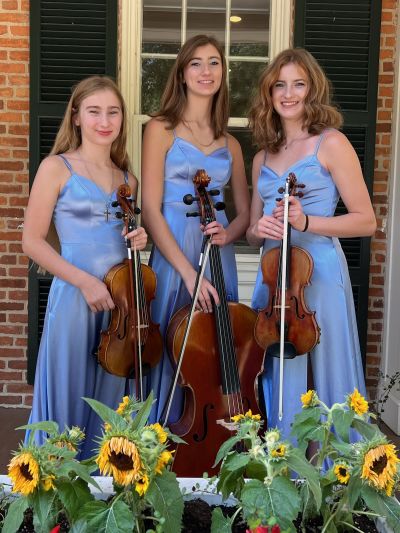
For the final performance of this concert program on November 17 at Nichols Concert Hall in Evanston, Orion welcomes back Naperville ensemble Black Pearl Trio - sisters Sofia Radovic, violin; Gabriela Radovic, viola (on piano for this performance); and Aleksandra Radovic, cello - performing Cafe Music for Violin, Cello and Piano by Paul Schoenfield. Orion coached Black Pearl at OPUS Chamber Music Camp.